No Black Jurors. Thirty-Five Years.
The Karmelo Anthony verdict is not only about one tragic death. It’s about what America calls justice after race has already made the decision.

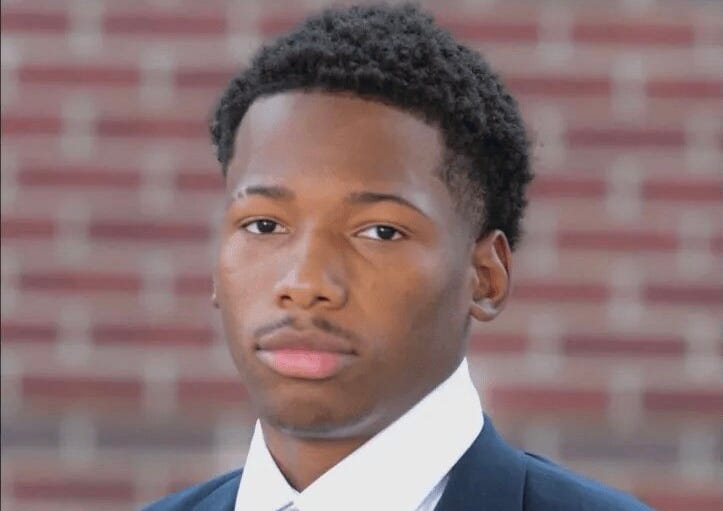
Karmelo Anthony was seventeen years old when he was in a confrontation that turned deadly. He said he was afraid. He claimed self-defense. But Black fear is almost never treated with the same seriousness as white fear in American courtrooms.
A jury rejected Karmelo’s self-defense claim, convicted him of murder, and sentenced him to thirty-five years in prison. This is part of why the anger is so intense.
People are not only reacting to one verdict. They are reacting to the same old pattern: Black children are expected to absorb danger, survive provocation, remain calm under threat, and then explain their fear perfectly after the fact. They are expected to do what people three times their age cannot.
Even if someone believes the jury reached the correct verdict, the sentence still forces us to ask a deeper question. What kind of justice system looks at a teenager, a chaotic confrontation between students, a contested claim of fear, and decides thirty-five years in prison is justice? Thirty-five years does not bring Austin back. It does not heal the Metcalf family. It does not make the community whole.
It simply takes another child’s future and buries it under the weight of the state.
The Charge Was Heavier Than the Facts
I understand why many Black people believe Karmelo Anthony had a right to defend himself.
That belief does not come out of nowhere. It comes from a lifetime of watching Black children get threatened, bullied, cornered, provoked, adultified, prosecuted, and then told their fear does not matter.
I understand that reaction because I know something about how fast racialized fear can become rage. I also know how easy it is for a young Black man, even a young Black man with a bright future, to suddenly stand at the edge of a life-changing mistake.
I wrote about this in my book, Redeem A Nation. When I was young, I was driving with a friend when a car full of white boys began taunting us—flipping us off, laughing, drinking, and then threw a bottle at my car. Well, I was young, hot-headed, and afraid, though I probably wouldn’t have called it fear at the time.
I chased them along dark country roads. When they turned down a dirt road and one of them jumped out and ran toward us, I foolishly hit the gas and tried to run him over. By the grace of God, he dove out of the way.
That moment still chills me because if I had hit him with my car, that one second would have changed everything. My life. His life. Our family’s lives. My future. My freedom.
So when Black people talk about fear, I don’t hear an abstraction. I know how quickly fear can become anger and racial humiliation can provoke a physical response. I know how quickly a young Black man can make a terrible decision in a moment he cannot ever get back.
That does not automatically justify the use of deadly force. But it should make us think hard about what we are judging. A teenager’s terrible decision in a racialized, emotionally charged confrontation is not the same thing as cold-blooded murder. The law should be able to see that difference. That is why I can hold three truths at once.
1. Karmelo Anthony had a right to be afraid and defend himself,
2. Deadly force does not seem to have been warranted.
3. The charge and sentence still outweigh the conduct.
Under Texas Penal Code § 9.32, the use of deadly force requires a reasonable belief that deadly force is immediately necessary to protect against another person’s use or attempted use of unlawful deadly force, or to prevent certain serious violent crimes. That is a high bar.
But Texas law also recognizes that not every unlawful killing is murder. Texas defines murder under Penal Code § 19.02 as intentionally or knowingly causing death, or intending serious bodily injury and committing an act clearly dangerous to human life that causes death. That is different from manslaughter under § 19.04, which requires proof that a person recklessly caused death. It is also different from criminally negligent homicide under § 19.05, which requires proof that a person caused death by criminal negligence.
Those distinctions are the difference between law and vengeance.
Yes, Karmelo Anthony should have faced accountability for taking Austin Metcalf’s life. But the law is supposed to match the charge to the mental state, circumstances, and level of culpability of the person charged. The more realistic, legally honest charge was manslaughter or criminally negligent homicide. Instead, the verdict looks like vengeance.
No Black Jurors
Also, this Black child was given his sentence by a jury with no Black jurors. The issue is not that every juror was white. The issue is that no juror was Black. No Black person sat in the jury box to examine self-defense, consider lesser offenses, or participate in deliberations. No one in the jury had lived the kind of fear Karmelo felt.
According to local Dallas TV Station FOX 4, the defense challenged the prosecution’s dismissal of three Black women as jurors. Prosecutors reportedly said the women were struck not because they were Black but because they were educators and the incident happened at a school
function involving schoolchildren. Whatever the reason, the outcome was the same: no Black jurors on a case where a young Black man’s future hung in the balance.
Now, I am well aware that having Black people on a jury does not guarantee the result Black people want. I am lead counsel for the family of Terence Crutcher in our ongoing federal civil rights fight. In 2017, former Tulsa Police Officer Betty Jo Shelby was acquitted after killing Terence, an unarmed Black man whose stalled vehicle had brought police to the scene. The jury included three Black jurors. There was video. There was national attention. There was a grieving Black family sitting in that courtroom waiting for accountability.
Betty Jo Shelby still walked away free.
Representation does not guarantee liberation. The argument or belief is not that Black jurors would have automatically acquitted Karmelo Anthony. It is that, given the massive, grotesque racial inequities demonstrated every day by our justice system, Black people should not be barred from a room where the State decides whether a Black child loses most of his life.
The Reverse Would Never Be Quietly Accepted
No honest person can pretend this country would allow an all-Black jury to judge a white boy accused of killing a Black boy in a nationally publicized case. Not only would there be an automatic mistrial and a national debate about whether the system had done enough to ensure public confidence, but there would be riots in the streets.
But when Black people raise the same concern, America rolls its eyes. This was not supposed to happen. The landmark 1986 Supreme Court case Batson v. Kentucky was supposed to stop prosecutors from removing jurors because of race. Batson involved a Black defendant in Kentucky whose prosecutor used peremptory strikes to remove all four Black prospective jurors from the jury pool. The Supreme Court said the Constitution does not permit prosecutors to exclude jurors simply because they are Black or because the prosecutor assumes Black jurors will be partial to a Black defendant.
A prosecutor can ask to remove a juror “for cause” when there is a reason the person cannot be fair or is not legally qualified. But a peremptory strike is different. It allows a lawyer to remove a juror without cause, but it cannot be used as a cover for racial exclusion. That principle should mean something when Black jurors are struck and the final jury has no Black people on it. Apparently, it does not.
Batson has become weak because too many courts allow neutral language to do too much work. The defense raises its concern. The prosecutor counters with a “race neutral” reason. No matter how flimsy that reason is on its face, the court accepts it and the case moves forward. But race does not disappear because the lawyer avoided saying the word.
The Supreme Court has already shown courts how to do better. In Flowers v. Mississippi, the Court examined how Black jurors were questioned and struck compared to white jurors who were allowed to serve. That kind of analysis matters because discrimination often reveals itself through patterns, uneven treatment, and the difference between what power says and what power does.
The Rule of Law Is at Stake
This case is not happening in a vacuum. It arrives in the middle of a broader civil rights rollback. Voting rights remain (on paper) while access is narrowed. Equal protection remains (on paper) while proof becomes harder. Civil rights laws remain (on paper) while enforcement weakens. Batson remains (on paper) while Black jurors can still disappear from the jury box.
When the legal system launders racial exclusion through neutral language, it does not only injure Black defendants. It undermines the rule of law for everyone. The rule of law depends on legitimacy, on the public believing reasons are real, rules are applied evenly, charges are proportionate, and outcomes are not predetermined by race, class, politics, or power.
That is why this is not only a Black issue.
It is an American issue.
Author’s Note
This piece grows out of Redeem A Nation and my work as founder, president, and chief legal counsel of Justice for Greenwood, which exists to repair harms caused by racial and economic violence.